
The Enduring History of High Heels
The Enduring History of High Heels
Today, high heels are a familiar symbol of glamour and femininity, but their origins are surprisingly gritty. Long before they graced red carpets, various forms of elevated footwear served practical, ceremonial, professional, and military purposes. From ancient platforms to Persian riding heels, raised shoes underwent centuries of change before becoming markers of wealth, status, and fashion.
Blood, Mud, and the Stage
One popular story claims that ancient Egyptian butchers wore raised shoes to keep their feet above the blood of slaughtered animals. The explanation is plausible but unproven: there is no secure evidence that this was a customary practice, and any such footwear would probably have resembled a raised sole or platform more than a modern high heel.
In classical Greece and Rome, some actors wore thick-soled theatrical footwear that increased their height and contributed to their visibility and stage presence. Across medieval Europe, people strapped wooden “pattens” over or beneath their shoes to make their way through streets thick with mud and refuse.
In these early examples, elevation could provide protection, visibility, or symbolic stature. These shoes were not necessarily high heels in the modern structural sense, but they demonstrate the long-standing appeal of raising the foot above the ground.
One of the clearest functional predecessors of the constructed heel emerged from equestrian culture. Persian cavalrymen wore heels that helped prevent their feet from sliding forward through their stirrups. This allowed a rider to rise in the saddle and use a bow more effectively. The heel was not originally a fashion statement; it was a useful component of riding equipment.
From the Battlefield to the Palace

Heeled riding footwear became especially influential in Europe around the turn of the seventeenth century, when diplomatic contact with Persia attracted considerable attention. Persian envoys appeared in European courts wearing heeled riding boots, and aristocrats embraced similar styles. In a world where clothing signaled power, the heel suggested elite horsemanship and martial prowess.
Once absorbed into court culture, the heel’s purpose shifted. What had stabilized a rider could now elevate a nobleman at a ball.
During the Baroque period, heels became a staple of aristocratic menswear. They contributed to a rigid posture, elongated the leg, and created a commanding silhouette. Crucially, elaborate court heels were impractical for manual labor. Wearing shoes unsuited to physical work became a powerful status symbol: it demonstrated that the wearer did not have to work with his hands.
Height became a literal expression of hierarchy. In seventeenth-century France, King Louis XIV famously wore shoes with red heels and restricted their use at court, turning them into an emblem of royal favor and aristocratic status. Popes also traditionally wore red footwear, but this belonged to a separate religious and institutional history rather than to Louis XIV’s courtly fashion system.
In both settings, footwear could announce authority before the wearer spoke a word. In European court culture, heels were worn by both men and women—they communicated privilege and fashionable distinction rather than belonging exclusively to one gender.
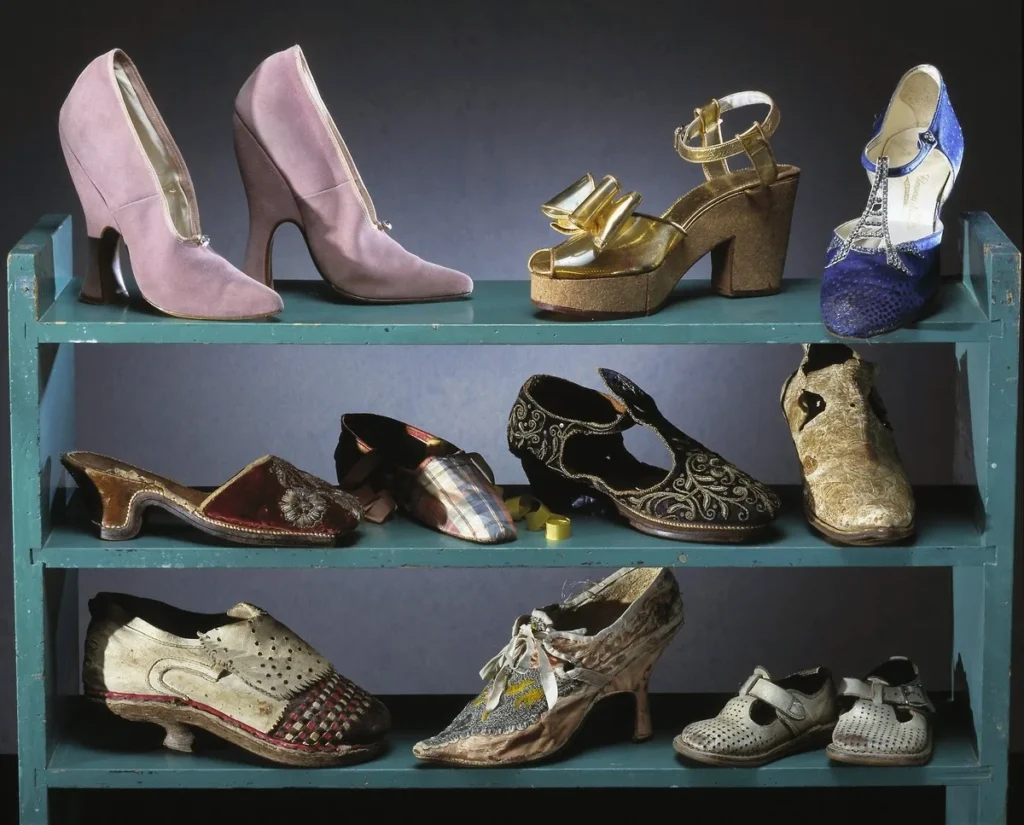
Museum display of shoes. Photo: Birgit Brånvall / Nordiska museet. CC BY 3.0 Norway. Modified with a vintage effect.
A Change of Purpose
The association between heels and masculinity did not collapse overnight; it faded gradually. During the eighteenth century, Enlightenment ideals encouraged greater restraint and practicality in men’s dress. Frills and ornaments diminished, and men’s heels became lower until they largely disappeared from fashionable wardrobes.
Women continued to wear heels during parts of this transition, allowing elevated shoes to acquire an increasingly feminine cultural meaning. The change, however, was neither immediate nor uninterrupted.
The French Revolution accelerated the rejection of aristocratic excess, and men’s clothing became markedly more sober. Women’s footwear also became flatter around the turn of the nineteenth century as delicate slippers and low shoes came into fashion. Heels subsequently returned to women’s dress and became increasingly associated with femininity, while remaining largely absent from mainstream men’s fashion.
The shoe itself changed alongside its cultural ownership. Heel height, shape, construction, and purpose continued to evolve as the high heel moved from aristocratic menswear into predominantly feminine fashion.


Eighteenth-century heeled shoe in gold and red (Wikimedia Commons, CC BY-SA 3.0)
The Biomechanics of Beauty
Despite centuries of changing styles, elevated heels have continued to affect the way their wearers stand and move. Raising the heel generally shifts pressure toward the front of the foot and can alter ankle position, posture, balance, and gait.
Those effects are not identical in every shoe or on every wearer. They vary according to heel height and placement, the shoe’s pitch and fit, toe-box shape, platform thickness, and the amount of support provided. A broad Persian riding heel, an aristocratic court shoe, and a modern stiletto therefore do not produce precisely the same physical experience.
The history of the high heel is about both reinvention and recontextualization. Its construction changed repeatedly, while each era also gave elevated footwear a different story and social meaning.
Heels for the Masses
The nineteenth century revolutionized how shoes were made. Industrialization gradually moved much of shoemaking from the artisan’s workshop to the factory floor. Sewing machinery sped up production, standardized sizing made ready-made footwear more practical, and increasingly divided manufacturing processes allowed shoes to be produced on a much larger scale.
This shift helped democratize the heel. Once largely restricted to people who could afford individually made shoes, fashionable heeled footwear became increasingly available in shops and department stores and entered middle-class wardrobes. Elevation was no longer something reserved for a narrow courtly elite; it was something a growing number of consumers could buy.
Yet even as machines transformed production, a raised heel continued to pitch the foot forward. Political revolutions, technological innovations, and economic expansion changed who could wear heels and how the shoes were constructed, while the basic principle of elevating the rear of the foot remained.
The Stiletto Era and Beyond
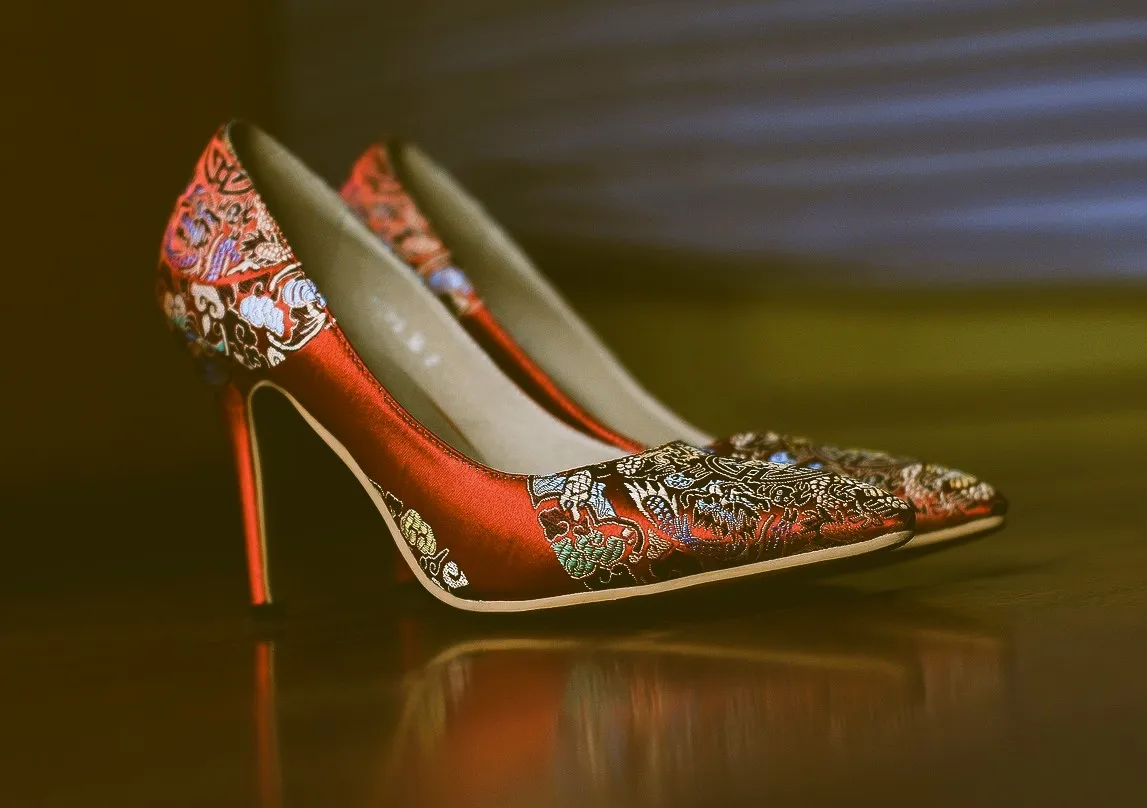
If the nineteenth century mass-produced the heel, the twentieth century radically expanded its possibilities.
By the mid-twentieth century, shoemakers were using strong internal metal supports that allowed heels to become exceptionally slender without breaking under the wearer’s weight. The origins of the stiletto cannot be credited securely to one designer, but advances in construction helped make its distinctive form possible. Slender, towering, and sharply tapered, the stiletto became one of the defining shoes of the 1950s.
The stiletto intensified the heel’s effects on posture, balance, and gait, concentrating height in a dramatic silhouette. From postwar Hollywood glamour to later professional settings, high heels could communicate authority, polish, sexuality, or deliberate self-presentation. At the same time, they could reflect gendered expectations and pressure to conform. Their meaning was never simply one of empowerment.
Today, the heel continues to evolve. Designers have also brought heels back into contemporary menswear, recalling earlier centuries when elevation communicated rank and style rather than belonging exclusively to one gender.
From Persian riding equipment to the steel-supported stiletto, the high heel has endured by repeatedly changing its form and absorbing the priorities of each era through which it has walked.